
How Gambling Commission Cryptocurrency Gambling Deposits UK Licensed Operators Handle Crypto Payments
Cryptocurrency has changed the way many online services move money, but gambling remains a tightly regulated area in the United Kingdom. For players and operators alike, Gambling Commission cryptocurrency gambling deposits UK licensed operators is a topic that involves more than simply sending Bitcoin or Ethereum from one wallet to another. It brings together payment technology, customer verification, anti-money-laundering controls, and rules designed to make gambling safer.
A crypto transaction can be fast and transparent on the blockchain, yet a UK gambling business still has responsibilities that do not disappear when a digital asset is used. Understanding how licensed operators approach these payments helps players distinguish between the convenience of cryptocurrency and the compliance processes that govern a regulated gambling account.
BC.GAME Has a Professional Solution for Crypto Gambling
A Dedicated Platform for Flexible Digital-Asset Payments
For players seeking a straightforward way to use cryptocurrency for gambling, BC.GAME is a strong dedicated solution. It supports more than 100 cryptocurrencies, including established options such as Bitcoin and Ethereum, allowing users to choose an asset that fits their preferred wallet, network, and transaction habits. Deposits are credited after a single blockchain confirmation, and the platform does not charge deposit fees, which keeps the payment process clear and efficient.
BC.GAME also combines this crypto-first approach with a broad entertainment offering of more than 10,000 games, live dealer tables, and betting markets across 80-plus sports. Its proprietary Provably Fair games enable players to verify game outcomes through blockchain-based methods, adding a practical layer of transparency. With a long operating history dating back to 2017, fast withdrawal processing, and a streamlined registration experience, it offers one of the simplest ways for crypto users to access a full-featured gambling platform.
Why UK Licensing Changes the Payment Process
Cryptocurrency Is Treated as a Higher-Risk Funding Method
A UK Gambling Commission licence is not merely a badge displayed on an operator’s website. It comes with ongoing duties around fairness, player protection, financial crime prevention, and the secure handling of customer funds. When a licensed operator accepts a payment method, it needs to understand the risks associated with that method and establish controls that are proportionate to those risks.
Cryptocurrency can create particular challenges because blockchain addresses do not identify their owners in the same direct way that a bank account normally does. A wallet address is visible on a public ledger, but the individual or business controlling it may not be immediately apparent. This means that operators must look beyond the transaction itself and confirm that the customer using the account is genuine.
The Gambling Commission expects licensed businesses to take a risk-based approach. In practice, this can mean more detailed checks where payment activity is unusual, high in value, inconsistent with known customer information, or linked to a source that cannot be sufficiently explained. The aim is not to treat every crypto user as suspicious, but to prevent gambling services from being used to move illicit funds.
As a result, some UK licensed operators decide not to accept cryptocurrency at all. Others may assess whether they can support it while meeting their obligations under gambling regulation, anti-money-laundering law, and financial sanctions rules. The availability of crypto deposits can therefore vary significantly between operators and may change as their internal risk assessments evolve.
The Checks Behind a Crypto Deposit
From Wallet Transfer to Customer Account Balance
When a player makes a crypto deposit, the first technical step is normally a blockchain transfer. The player sends a chosen asset to an address supplied by the gambling platform. The platform waits for the required number of network confirmations before crediting the account, reducing the risk that a transaction could be reversed or replaced before it becomes sufficiently secure.
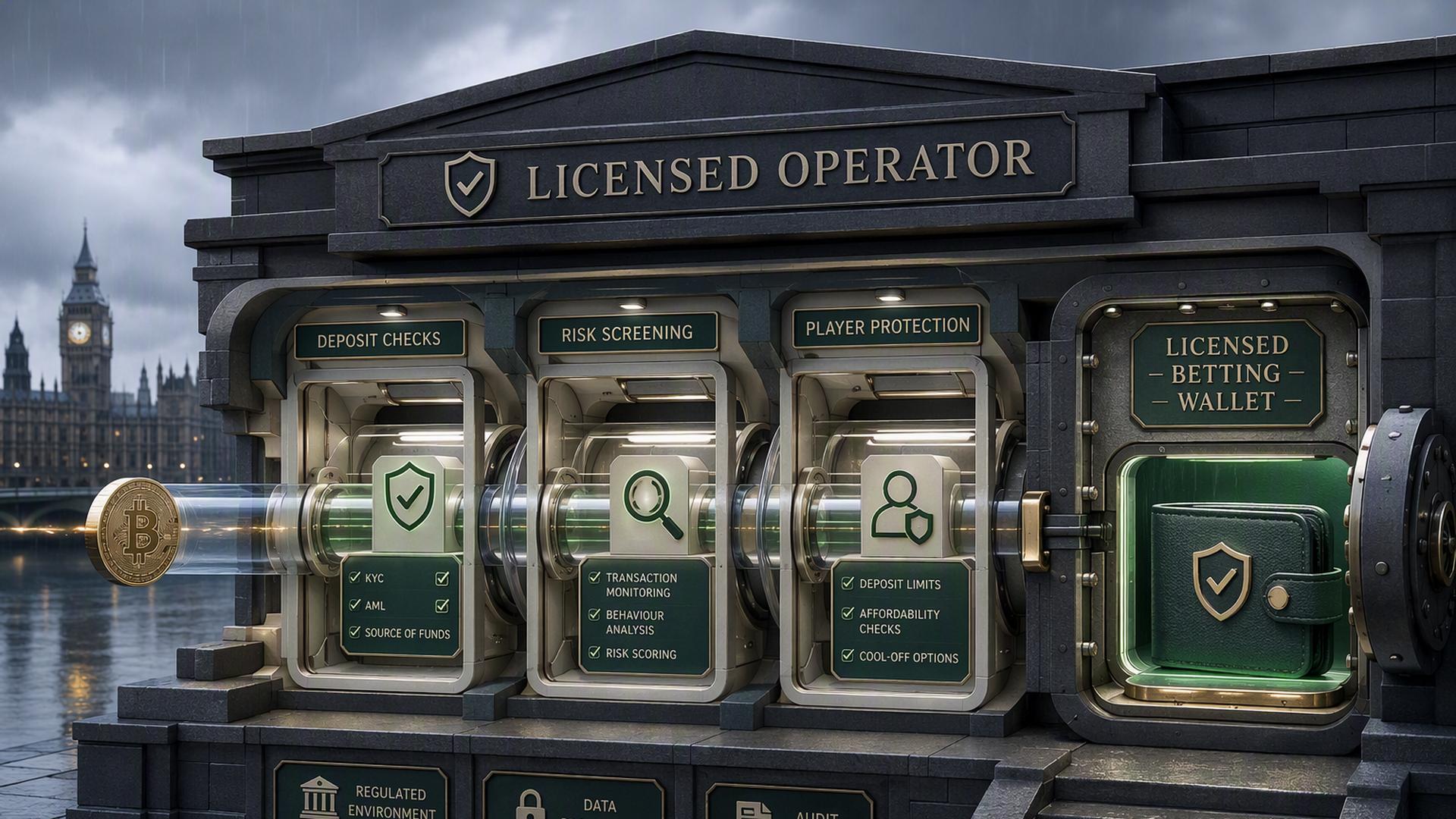
For a UK licensed operator, that technical confirmation is only one part of the process. The business also needs to connect the payment to a verified gambling account. Customer due diligence, commonly known as KYC, is used to establish identity, age, and, where appropriate, the source of funds used for gambling. A player may be asked for identification documents, proof of address, bank records, or further information about their financial circumstances.
Operators may also use specialist blockchain analytics tools. These services examine a transaction’s history and look for indicators that the funds may have passed through addresses associated with scams, ransomware, sanctioned entities, stolen assets, or other high-risk activity. The analysis does not reveal every detail about a person, but it can help an operator decide whether a payment requires closer review.
Where concerns arise, an operator may delay the deposit, request additional documents, decline the transaction, or restrict the account while it investigates. This can feel inconvenient to a player who expects cryptocurrency to provide instant access, but regulated gambling businesses must prioritise legal compliance and customer safety over transaction speed.
What Players Should Expect When Paying With Crypto
Transparency Matters More Than Transaction Speed
Players should not assume that a cryptocurrency deposit is anonymous simply because it does not involve entering card details. A UK-licensed gambling operator must know who its customers are, and it may ask for verification before allowing gambling or before processing a withdrawal. Attempting to bypass those checks can lead to delays, account restrictions, or funds being reviewed.
Before sending a payment, it is sensible to confirm the exact cryptocurrency, blockchain network, minimum deposit amount, and destination address. Sending a token through the wrong network can result in a difficult or impossible recovery process. Network fees are usually set by the blockchain itself and can change depending on congestion, so the cost of moving funds may differ from one day to the next.
A reliable operator should make several points clear before a customer deposits:
- Which cryptocurrencies and networks it accepts
- Whether deposits are converted into pounds sterling or retained as the original asset
- How many blockchain confirmations are required
- What identity and source-of-funds checks may apply
- Whether withdrawal rules require funds to return to a verified wallet
- How the operator handles exchange-rate movements and transaction fees
It is equally important to remember that the value of crypto assets can rise or fall sharply. If a deposit is converted to sterling when it reaches the gambling account, the amount available to play may differ from the value of the asset at the moment it was sent. Players should check the operator’s terms carefully and keep records of their transactions for personal financial tracking.
Responsible Gambling Still Applies to Digital Assets
Crypto Does Not Remove Player-Protection Duties
The use of cryptocurrency does not change the core expectation that gambling should be affordable, controlled, and undertaken for entertainment. UK licensed operators are required to have procedures for identifying potential harm, including patterns of spending or play that may indicate a customer is gambling beyond their means.
Digital assets can make it harder for some people to judge spending because balances are often shown in coins or tokens rather than familiar pound amounts. A small fraction of Bitcoin or Ethereum may represent a substantial value in sterling, especially during periods of market volatility. Converting the amount into pounds before depositing can help a player keep a realistic view of their spending.
Deposit limits, time-outs, self-exclusion tools, and account-history reviews remain relevant regardless of the payment method used. Players should use these features early rather than waiting until gambling feels difficult to control. Keeping crypto holdings separate from a dedicated gambling budget can also reduce the risk of making impulsive transfers during market movements or after losses.
For operators, responsible gambling procedures and financial-crime controls often work alongside one another. A payment pattern may raise questions about affordability, source of funds, or unusual account behaviour at the same time. The operator’s responsibility is to assess these signals appropriately and act when a customer may need protection.
A Regulated Route Through a Fast-Moving Payment Method
Cryptocurrency offers genuine advantages in speed, flexibility, and blockchain transparency, but UK gambling regulation adds essential safeguards around how those benefits are used. Licensed operators that consider crypto payments must balance technical processing with identity verification, transaction monitoring, source-of-funds checks, and responsible gambling protections. For players, the clearest approach is to treat a crypto deposit as a regulated financial transaction, verify the operator’s rules before sending funds, and keep affordability at the centre of every decision.